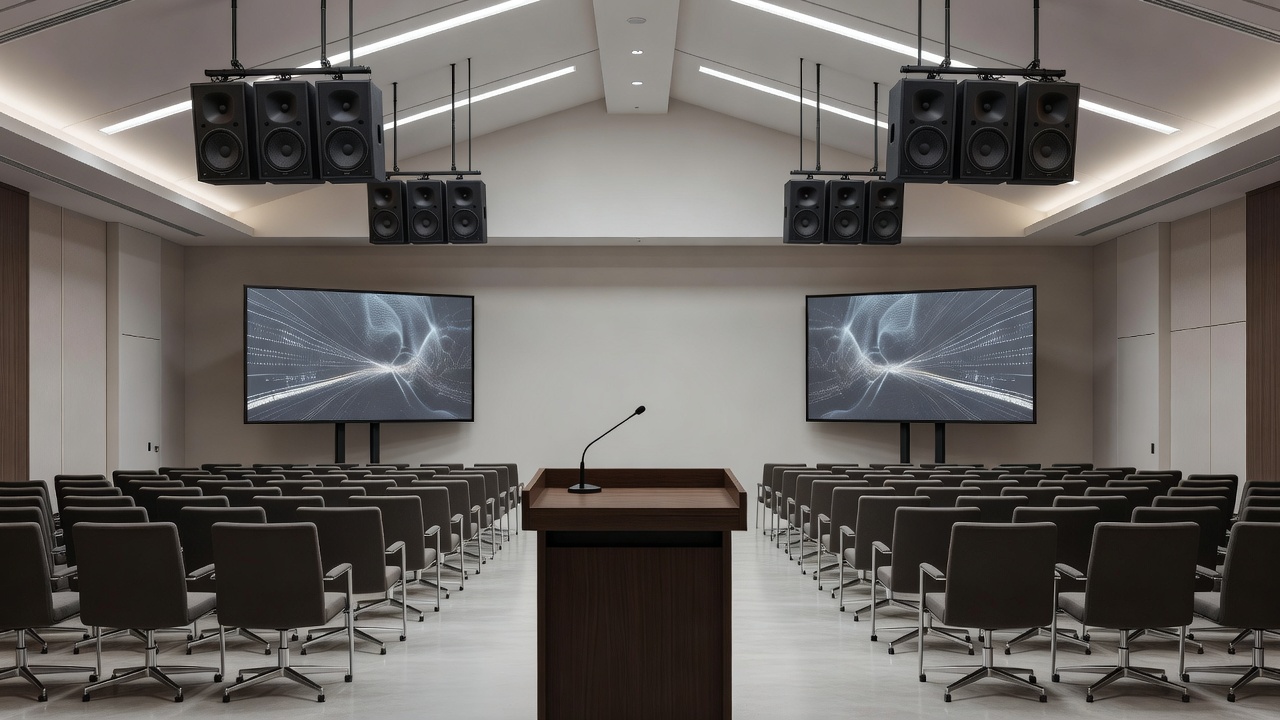
Conference Audiovisual Infrastructure
Conferences differ from informal meetings in size, acoustic complexity, and schedule rigidity. A single malfunctioning connection interrupts hundreds of attendees. Operational success requires dedicated signal distribution, clean video switching with seamless preview feeds, and acoustic management that suppresses reverberation and acoustic feedback.
CuriosityQuibly delivers modular conference AV packages designed around operational reliability. Our flight racks house integrated digital signal processors (DSPs), seamless 4K presentation switchers, power sequencing units, and digital stage boxes that consolidate cabling into single optical runs.
Microphone Systems and Room Coverage
Large conference halls require multiple microphone types deployed simultaneously:
- Lectern Goosenecks: Dual-capsule condenser microphones configured on shock mounts to isolate lectern taps, page turning, and floor vibration.
- Panel Discussion Arrays: Push-to-talk delegate units or automated boundary microphones managed by automixing algorithms that attenuate inactive channels.
- Q&A Roving Microphones: Heavy-duty handheld transmitters with high-rejection cardioid capsules, handled by event runners for delegate questions.
- Keynote Lavaliers and Headsets: Omnidirectional micro-capsules color-matched to presenters, eliminating proximity bass-boost artifacts.
Speaker Placement & Acoustic Calculations
Placing two large speakers at the front of a deep room fails acoustic fundamentals. Increasing volume at the front deafens front-row executives while words remain garbled at the rear due to room reverberation.
We implement distributed sound systems. Front-of-house column line arrays provide focused vertical dispersion that limits reflections off ceilings and floors. In rooms exceeding 18 meters in depth, delayed satellite speakers are positioned along the sidewalls. Digital delay units align satellite arrival times with front acoustic wavefronts within 1 millisecond, maintaining perfect speech intelligibility across all rows.
Lectern & Presenter Coordination Equipment
The presenter interface must remain foolproof. We outfit lecterns with dedicated presenter consoles containing:
| Component | Functionality | Redundancy Feature |
|---|---|---|
| Lectern Display | 1080p confidence monitor showing current slide and speaker notes | Direct hardware HDMI loop-through |
| Countdown Clock | High-visibility digital timer synchronized with stage manager console | Manual override + battery backup |
| Dual Clicker System | RF presentation remotes with USB receiver pairing across two laptops | Simultaneous slide advance on primary & backup machines |
| Connection Pigtail | Retractable braided cable providing HDMI, USB-C, and DisplayPort | Built-in EDID retainers prevent display re-handshake delay |
Cable Routing, Safety, and Technical Space
Temporary conference cabling represents a physical safety hazard if managed incorrectly. All cable pathways crossing delegate transit routes are housed within industrial interlocking rubber cable ramps. Stage cabling is taped using low-residue matte gaffer tape along wall perimeters.
The control position (front-of-house technician desk) requires a minimum 2m x 2m operational footprint, placed with an unobstructed direct view of the stage. This allows technicians to monitor sightlines, observe speaker movements, and adjust mixing levels instantaneously.
Operational Planning Advice
Conference AV success depends on timely rehearsal schedules. Presenters bringing personal laptops must undergo a connection check at least 45 minutes before session commencement. Corporate operating system security policies, unusual screen resolutions, and USB-C hardware variations must be validated beforehand to prevent stage delays.