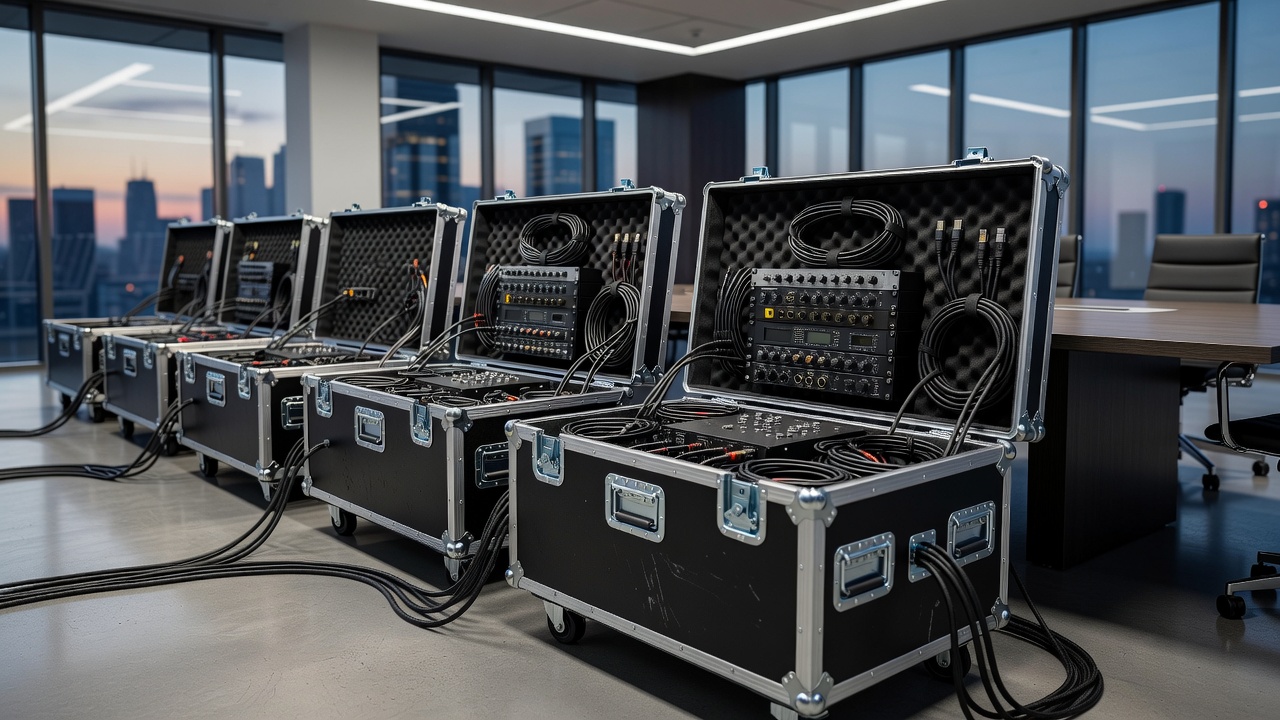
Temporary Equipment Requirements
Standard office meeting rooms often lack the audiovisual capacity required for high-stakes corporate gatherings. Internal screens are frequently undersized for rooms exceeding ten attendees. Existing webcam bars fail to capture speech beyond three meters. Temporary equipment rental solves capacity shortages without permanent capital expenditure or facility structural modification.
Our rental stock is organized into modular flight packs. Each pack addresses room layout, participant headcount, presenter device compatibility, and electrical supply constraints. We eliminate consumer-grade adapters that drop signal during high-resolution desktop handshakes.
Core Equipment Categories in Circulation
| Category | Standard Components | Typical Application |
|---|---|---|
| Commercial Displays | 55", 65", 75", 85", and 98" 4K LCD panels on wheeled truss stands | Executive boardrooms, break-out training sessions, side monitors |
| Laser Projectors & Screens | 7,000 to 12,000 ANSI lumen laser engines with fast-fold projection surfaces | Ballroom corporate presentations, shareholder gatherings, wide rooms |
| Microphone Bundles | Digital wireless handhelds, discreet lavaliers, and table boundary pucks | Panel discussions, lectern keynotes, boardroom question-and-answer |
| Speech Sound Systems | Powered column line-array speakers with DSP feedback control | Even acoustic coverage across long or wide conference spaces |
| Stands & Hardware | Dual-pole rolling carts, heavy steel baseplates, safety cable stops | Secure mounting without drilling or building anchors |
| Cabling & Distribution | Active optical HDMI 2.1, 12G-SDI, USB-C ingest docks, Cat6A reels | Lossless signal transmission across 10m to 50m cable runs |
Display Sizing & Room Dimensions
Correct display selection follows standard 4:6:8 viewing distance ratios. In a 6-meter meeting room, a 65-inch screen delivers sufficient legibility for presentation typography. In a 12-meter room, viewers at the rear cannot read 10-point financial spreadsheets on anything smaller than an 85-inch or 98-inch display, or an appropriately calibrated 130-inch projection surface.
Ambient lighting conditions dictate display technology. Rooms with direct daylight through non-blinded windows overwhelm low-output consumer televisions. We deploy commercial displays rated at 500 to 700 nits, equipped with matte anti-glare coatings, or high-output laser projectors that overcome room illumination.
Audio Hardware: Microphones and Speakers
Speech intelligibility is the most critical operational variable. A meeting can survive a dropped slide; it cannot proceed if attendees cannot comprehend spoken numbers or quarterly results.
We supply digital wireless systems operating in clear frequency bands. Wireless transmitters are pre-paired with receivers and checked against local RF spectrum interference. For boardrooms, we supply boundary microphones with cardioid pickup patterns that reject ambient air-handling hum. For keynote presenters, we supply slimline directional headset microphones that maintain consistent distance from the speaker mouth, avoiding gain drops during head turns.
Rental Durations & Delivery Logistics
Equipment is rented across single-day sessions, multi-day conferences, or monthly corporate trial periods. Dispatch timing requires delivery at least two hours prior to presenter access. For large multi-room configurations, setup must occur the preceding afternoon to allow full network and audio testing.
All hardware arrives flight-cased on heavy-duty casters. Delivery personnel verify elevator load capacities, doorway clearance, and loading bay parking permits before dispatch.
Operational Limitations of Rental Equipment
Renting temporary equipment offers immense flexibility, but operators must understand inherent limitations. Temporary wiring requires floor ramps or gaffer taping to ensure delegate safety. Cabling cannot be hidden inside walls without permanent installation. Furthermore, temporary AV equipment depends on the building electrical capacity; multiple large displays and amplifier racks must be balanced across separate phase breakers to prevent tripping building circuits.