The Technical Demands of Hybrid Rooms
Hybrid meetings present a symmetrical challenge: in-room participants must hear and see remote callers clearly, while remote attendees must receive clean speech and tight framing of local speakers without room reverberation or echo loops.
Standard consumer laptops running Teams or Zoom through internal microphones fail in corporate boardrooms. The built-in microphone picks up paper shuffles and HVAC whine while compressing human speech. Our hybrid equipment bundles replace laptop peripherals with dedicated broadcast-grade capture, hardware DSP processing, and multi-camera switching.
Camera Placement and Optical Framing
Placing a single wide-angle webcam at the far end of an 8-meter table creates a "bowling alley" view. Room participants appear tiny, facial expressions are lost, and remote attendees disengage.
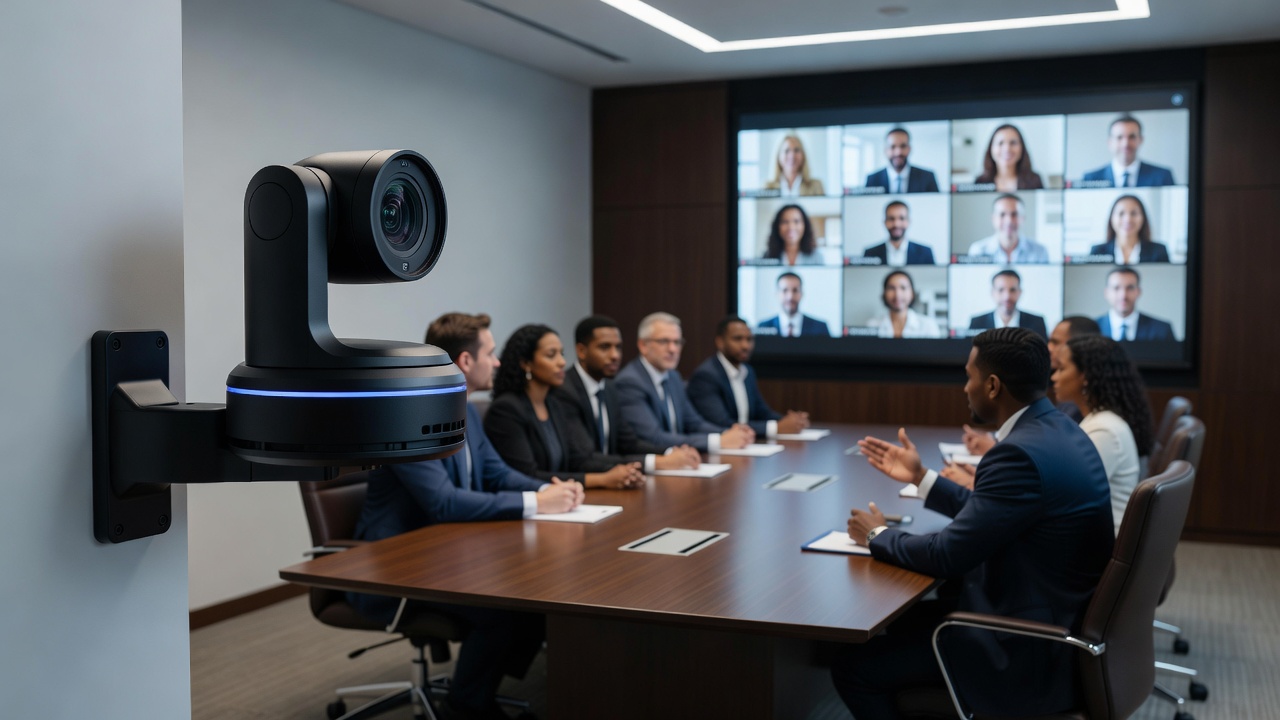
We deploy professional PTZ (Pan-Tilt-Zoom) cameras equipped with 20x or 30x optical zoom mechanisms and silent servo motors. We configure a minimum two-camera setup:
- Camera 01 (Stage / Podium Framing): Positioned at eye-level on a dedicated rolling riser, calibrated to capture the active speaker with tight head-and-shoulders framing.
- Camera 02 (Room Wide Shot): Mounted centrally to capture the complete room context, returning remote participants to the collective physical room feeling.
- Hardware Joystick Controller: A technician or designated operator triggers preset framing coordinates with single-button recalls, avoiding disruptive manual camera searching.
Acoustic Echo Cancellation (AEC) & Dante Ingest
The primary failure mode in hybrid meetings is the audio feedback loop. Sound emitted by in-room loudspeakers enters the in-room microphones and returns to the remote caller as a delayed, disorienting echo.
Our hybrid racks feature dedicated hardware DSP engines with Acoustic Echo Cancellation (AEC). The DSP takes the reference feed from the conference codec, calculates the room impulse response, and actively subtracts loudspeaker spill from the microphone mix before sending it back to the virtual meeting. This guarantees clean, full-duplex communication where both parties can converse simultaneously without speech cutting out.
Participant Visibility and Secondary Displays
Presenting content while simultaneously observing remote participants requires dual or triple visual display feeds. In a single-screen room, shared spreadsheets minimize remote webcam squares to unreadable thumbnails.
| Display Channel | Hardware Allocation | Operational Role |
|---|---|---|
| Content Screen | 75" to 98" Primary 4K Panel | Displays presenter deck, software demo, or financial data |
| Gallery Screen | 55" to 65" Secondary Panel | Dedicated 49-attendee remote video grid |
| Presenter Return | 43" Confidence Wedge at Podium | Shows what remote participants currently see |
Network Dependencies & Limitations
Audiovisual rental equipment delivers uncompressed local signal paths, but it cannot override venue network limitations. A hybrid broadcast requires dedicated, unthrottled corporate bandwidth.
We require venues to provide a hardwired Cat6 Ethernet connection with a minimum 25 Mbps symmetric upload/download profile, configured without captive portal logons. Public guest Wi-Fi networks are strictly incompatible with stable enterprise hybrid broadcasting due to packet loss, fluctuating latency, and aggressive firewall restrictions.